


From 14 to 18 September 2026, Budapest hosted the 53rd World Groundwater Congress of the International Association of Hydrogeologists (IAH), bringing together 856 groundwater professionals from more than 70 countries. The congress offered an outstanding international platform for ClimEx-PE researchers to present recent results related to nature-based groundwater management, Managed Aquifer Recharge (MAR), groundwater flow systems, climate resilience, water quality and groundwater education.
Several contributions were closely connected to the scientific and societal objectives of ClimEx-PE, which aims to develop and promote a groundwater-flow-informed, nature-based approach to climate adaptation.
A particular highlight was the session Nature-based solutions for sustainable groundwater management, co-chaired by Ádám Tóth (Utrecht University). The session brought together international research on how groundwater and subsurface processes can be incorporated into nature-based responses to water-related challenges.

Judit Mádl-Szőnyi (ELTE) presented Nature-based aquifer recharge: Experiments and models for public understanding. The presentation focused on the NaBa-MAR® concept, which links local Managed Aquifer Recharge interventions with the natural hydraulic and environmental effects of groundwater flow systems. A physical demonstration experiment and supporting numerical modelling were used to illustrate how locally infiltrated water becomes part of a wider groundwater flow system and may therefore generate effects beyond the immediate intervention site. The work also emphasised the importance of communicating these otherwise invisible subsurface processes to decision-makers and the public.

Szilvia Simon (ELTE) presented Effectiveness of surface water retention through canals in terms of groundwater, in the Danube-Tisza Interfluve, Hungary. The study evaluated a canal-based surface-water retention intervention at Bátya using field observations, hydrogeological and geophysical measurements, and numerical simulation. The results showed that infiltration effectiveness is strongly controlled by shallow geological conditions and that the hydraulic connection between canals and groundwater may vary considerably even along a single canal reach.
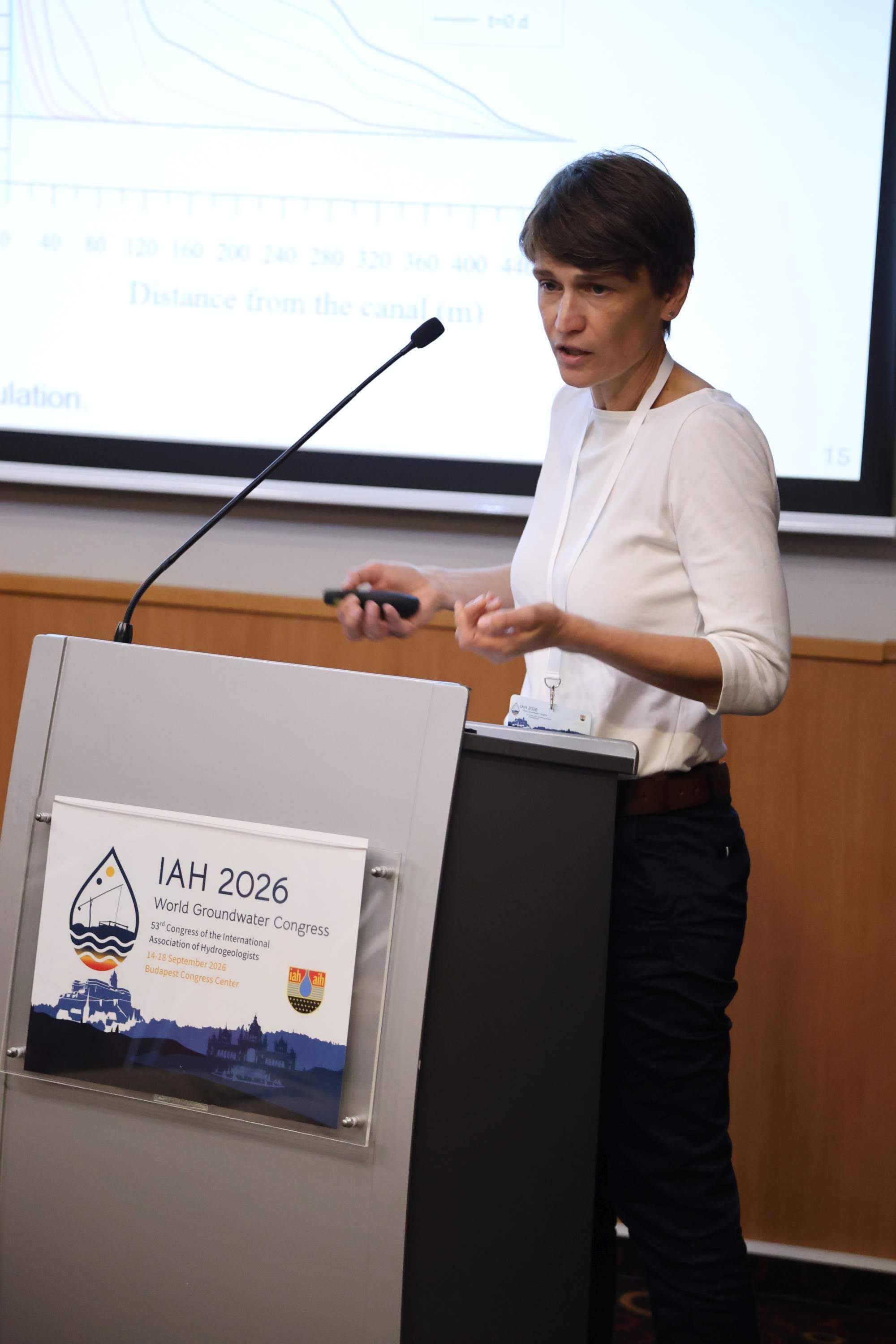
Márk Szijártó (ELTE) also presented the poster Numerical investigation of the effectiveness of managed surface water infiltration through surface canals in semi-arid areas, co-authored by Adél Petneházy, Szilvia Simon and Judit Mádl-Szőnyi. The study used numerical modelling together with field-based hydrostratigraphic information from Bátya, Hungary, to investigate how canal-based water retention influences groundwater. The results showed that effectiveness depends strongly on groundwater depth, subsurface hydraulic properties and the existing groundwater flow system. In particular, the influence of a single canal was found to be spatially and temporally limited, underlining the need for site-specific, integrated water-retention strategies rather than uniform interventions.

The broader scientific basis of groundwater-flow-informed solutions was represented by Brigitta Czauner (ELTE), who presented Tracking regional scale aquitard permeability using fully coupled groundwater flow models in the Central Pannonian Basin. Her study explored how aquitard permeability controls regional groundwater flow patterns, overpressure, salinity and temperature distribution, contributing to a better understanding of the subsurface processes relevant to sustainable groundwater management.
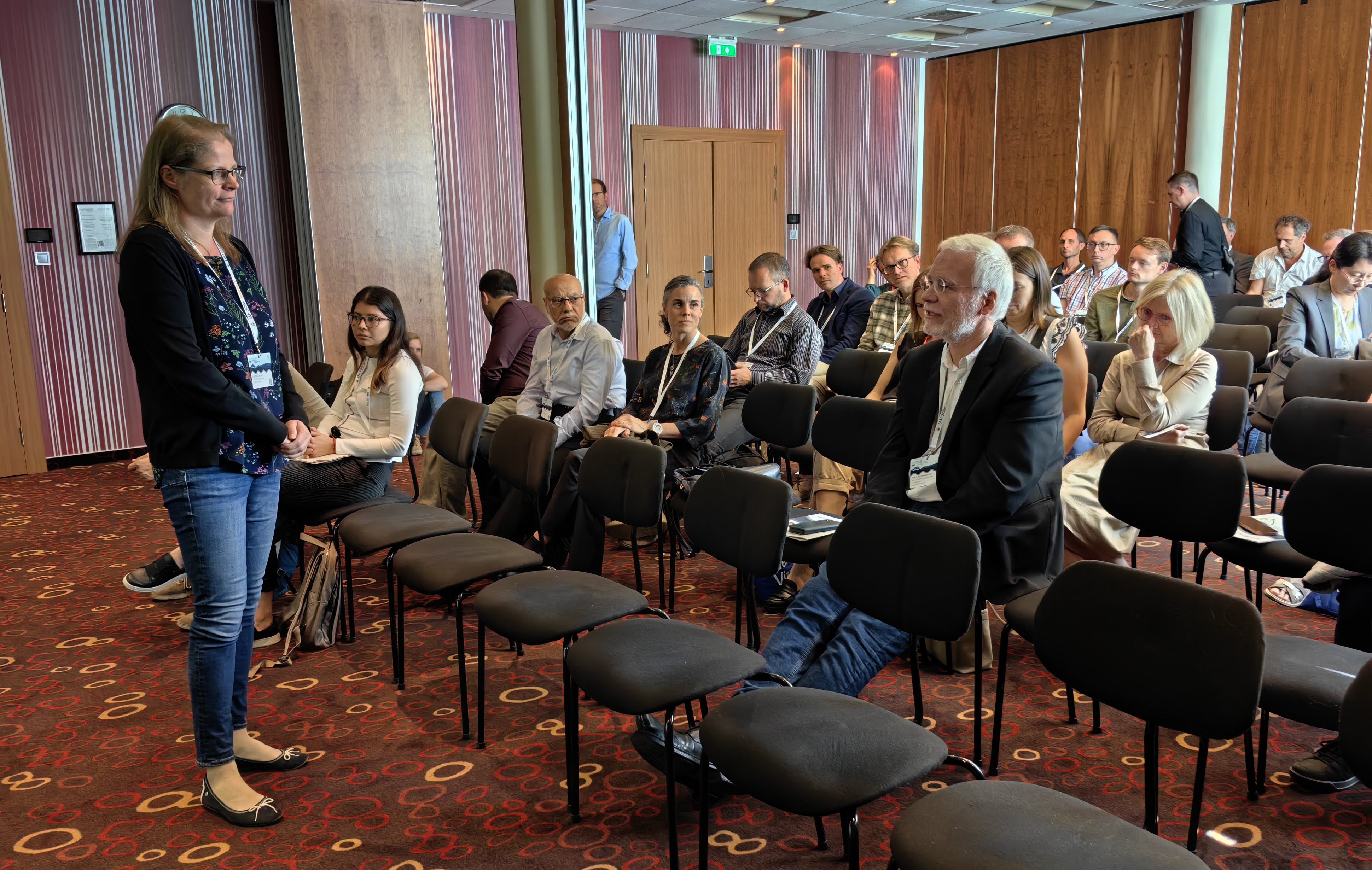
Climate-resilient water management through MAR was also addressed by Reham Mohammed (ELTE) in Treated wastewater reuse for sustainable agriculture using MAR approach. Case study: Kiskunfélegyháza, Hungary. Her work investigated the potential use of treated wastewater for groundwater recharge in an agricultural area affected by declining groundwater levels, highlighting the importance of understanding and actively managing groundwater–surface water interactions while ensuring appropriate water quality conditions.

The congress also showcased the public engagement and educational dimension of ClimEx-PE. Ildikó Erhardt (ELTE) presented Students’ knowledge and attitudes towards groundwater and Nature-Based Managed Aquifer Recharge – Effects of a short educational intervention. The ClimEx-PE study tested a 90-minute educational programme combining interactive activities, an educational film and structured teaching on groundwater flow systems and NaBa-MAR®. Results from 174 secondary-school and university students showed significant improvements in groundwater knowledge as well as more positive attitudes towards NaBa-MAR® and adaptation to hydroclimatic extremes.
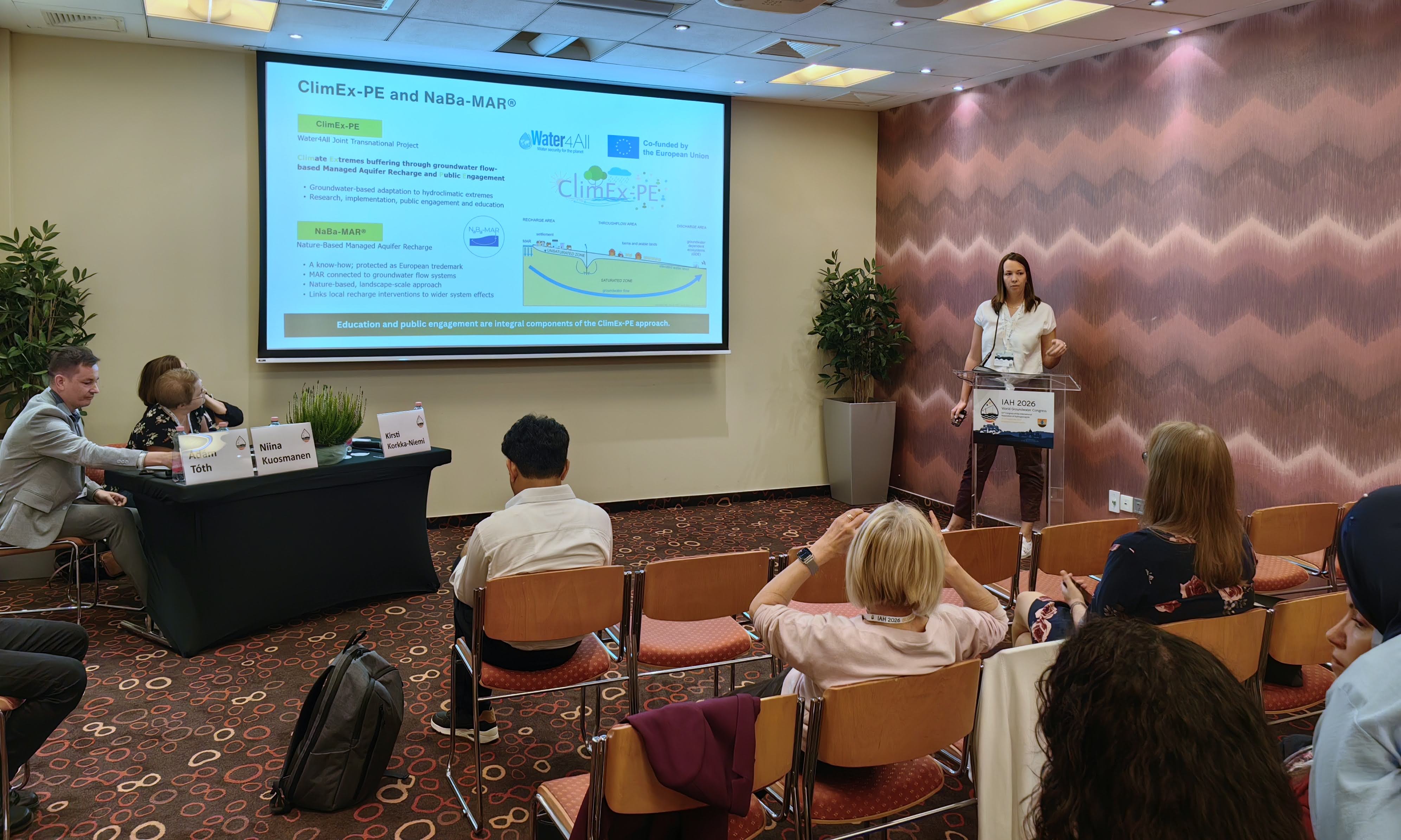
Ádám Tóth (Utrecht University) presented Educating for the green transition: embedding GreenComp in groundwater education. His contribution addressed how groundwater education can be connected to the European GreenComp sustainability competence framework, strengthening the link between hydrogeological knowledge and the competences needed for the green transition.
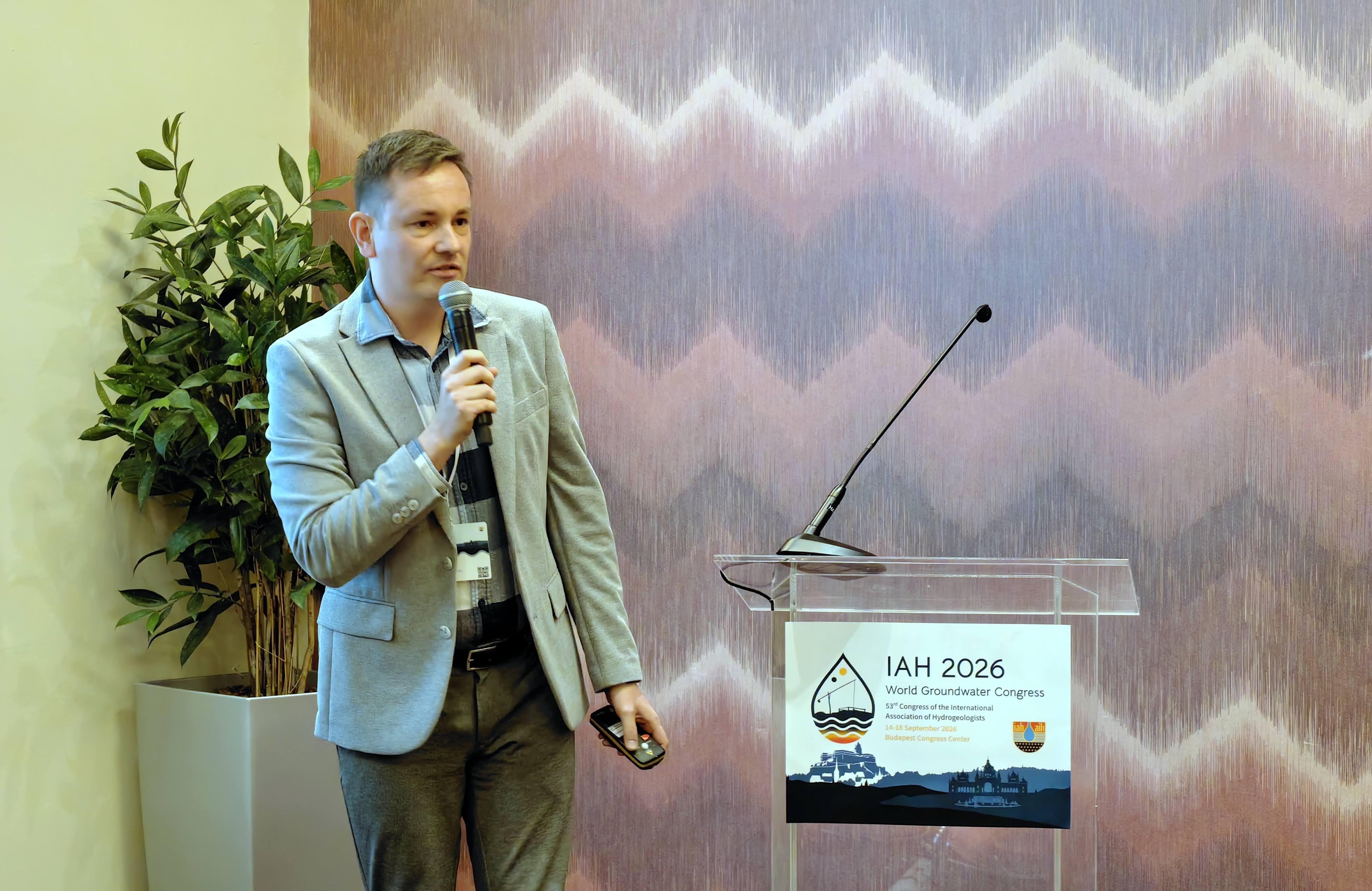
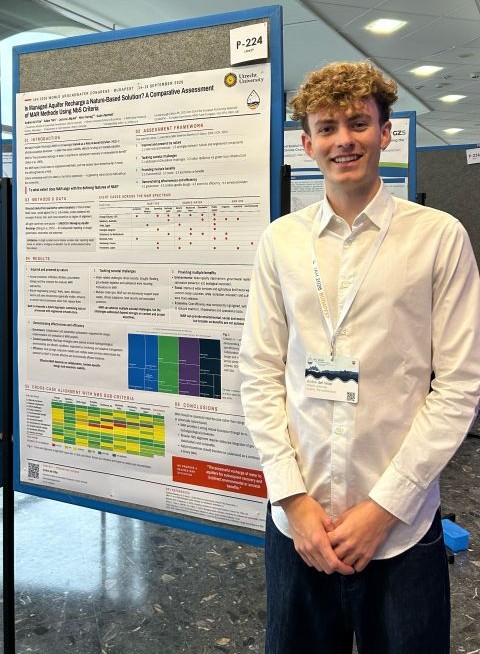
Andrei del Villar (Utrecht University) presented the poster Is Managed Aquifer Recharge a Nature-Based Solution? A Comparative Assessment of MAR Methods Using NbS Criteria, developed together with Ádám Tóth, Jessica Lillquist, Niels Hartog and Katrin Merfeld within ClimEx-PE. The study assessed eight documented MAR cases against four core Nature-Based Solution criteria and 11 sub-criteria, examining the extent to which different MAR approaches can be considered nature-based.The results suggest that MAR should not automatically be labelled as a Nature-Based Solution. While MAR has a strong natural foundation through infiltration, groundwater storage and flow, broader alignment with NbS principles depends on context-specific design, governance, stakeholder participation and the delivery of wider environmental, social and economic co-benefits. The study therefore proposes understanding the nature-basedness of MAR as a continuum rather than a binary category.
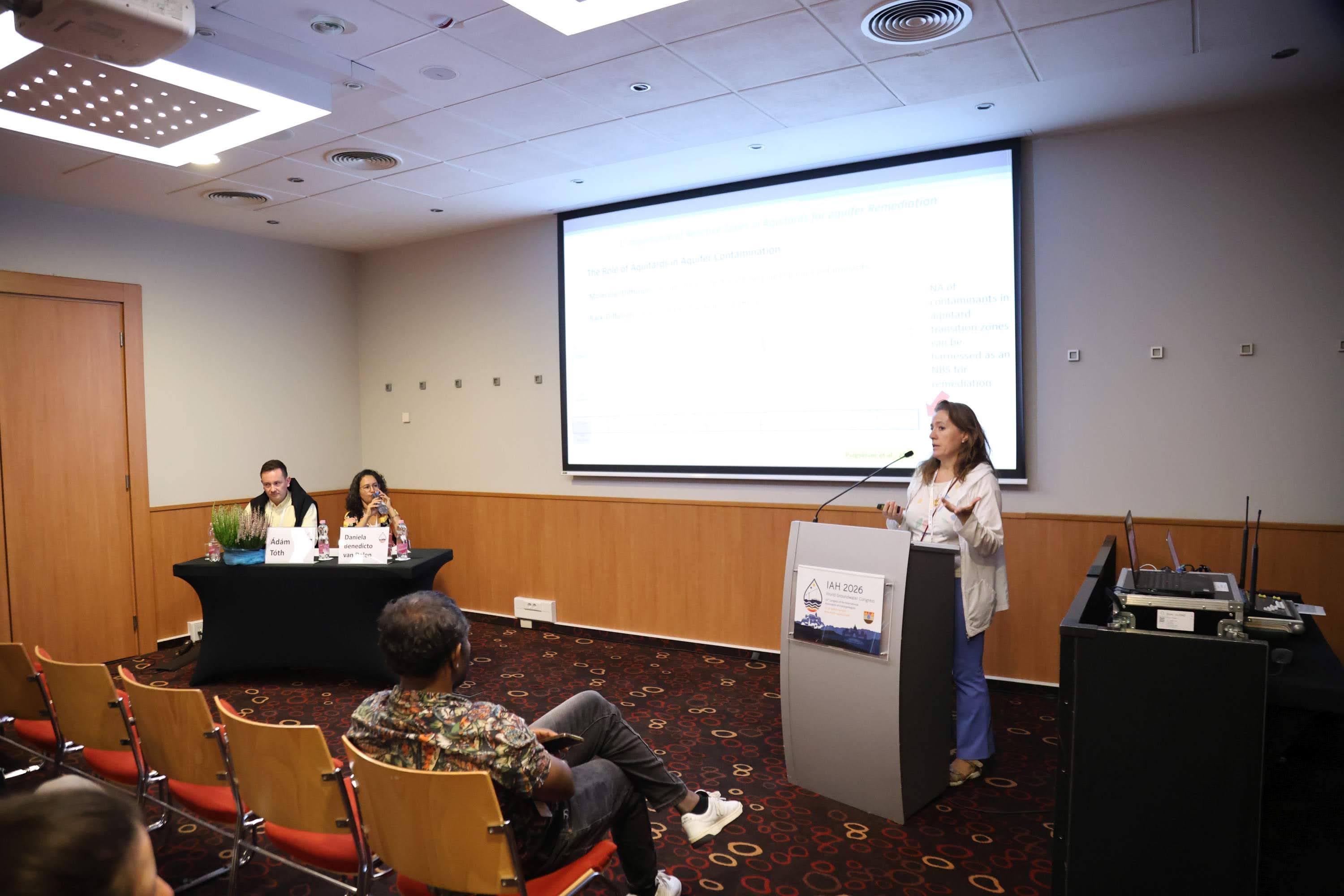
ClimEx-PE was also represented by its University of Barcelona partner. Diana Puigserver (UB) presented Activation of reactive zones in aquitards for the mobilization and degradation of persistent and emerging contaminants. The study examined how reactive zones within low-permeability aquitards can be activated through minimally invasive interventions to promote contaminant degradation, supporting a broader view of aquitards as potentially active components of nature-based groundwater remediation.
Diana Puigserver and colleagues also presented research on the natural attenuation of emerging and biological contaminants during Managed Aquifer Recharge using reclaimed water in coastal aquifers, directly linking groundwater quality, MAR feasibility, seawater-intrusion control and the protection of groundwater-dependent ecosystems.
The Budapest Groundwater Declaration: shared priorities with ClimEx-PE
A major outcome of the Congress was the Budapest Groundwater Declaration, adopted on 18 September 2026 as a collective message of the international groundwater community. The Declaration calls for stronger action on groundwater and stresses its fundamental role in water and food security, ecosystems, climate resilience and the green transition. It also calls for groundwater to be placed at the centre of policies, sustainable solutions, climate strategies and investment plans.
Several of its key messages closely reflect the approach taken by ClimEx-PE. The Declaration emphasises that groundwater and surface water form one interconnected resource and should be managed through a holistic “One Water” approach. This directly resonates with the scientific basis of ClimEx-PE: the project does not treat recharge as an isolated local intervention, but examines how infiltrated water enters natural groundwater flow systems and how subsurface flow connects recharge areas, discharge areas, surface waters and groundwater-dependent ecosystems.
This system-based perspective underpins the development of NaBa-MAR® as a landscape-scale, groundwater-flow-informed Nature-Based Solution for buffering hydroclimatic extremes.
The Declaration also highlights the importance of transdisciplinary approaches and the active participation of communities and stakeholders. This is closely aligned with ClimEx-PE, which combines hydrogeological research with societal, educational, legal and policy perspectives, while supporting stakeholder engagement and the practical implementation of groundwater-based climate adaptation solutions.
Another particularly relevant message is that education and communication are essential for making groundwater visible and meaningful to society. This is at the heart of ClimEx-PE’s public-engagement activities, which aim to improve groundwater literacy, develop and test educational materials, and communicate the role of groundwater and NaBa-MAR® in climate adaptation.
The Declaration also looks ahead to the 2026 United Nations Water Conference in Abu Dhabi, calling for groundwater to be firmly embedded in global water discussions and commitments.
Read the Budapest Groundwater Declaration:
https://iah2026budapest.com/Bp_declaration.pdf
Why was IAH 2026 important for ClimEx-PE?
Participation in the World Groundwater Congress offered ClimEx-PE much more than an opportunity to present individual research results. It brought several core elements of the project together within one major international forum: groundwater-flow-system science, Nature-Based Managed Aquifer Recharge, climate adaptation, groundwater quality, education and public engagement.
The congress provided an opportunity to connect research from ELTE, Utrecht University and the University of Barcelona with the wider international discussion on groundwater resilience and Nature-Based Solutions, exchange experience with researchers and practitioners facing comparable water challenges, and strengthen the visibility of ClimEx-PE within the broader Water4All community.
Importantly, the Budapest Groundwater Declaration showed that several ideas at the core of ClimEx-PE are also key priorities for the international groundwater community: managing groundwater and surface water as one interconnected system, placing groundwater at the heart of climate adaptation, developing transdisciplinary and participatory solutions, and strengthening education and communication around an often invisible resource.
The strong ClimEx-PE presence at IAH 2026 therefore demonstrated the value of combining hydrogeological process research, Nature-Based Managed Aquifer Recharge, water-quality protection and public engagement, while connecting the project’s results to a broader international agenda for groundwater sustainability.